

Preface
There is a mental model that separates the people who build lasting things from the people who spend their lives playing it safe and ending up with very little to show for it.
It is not intelligence. It is not even timing, though timing matters.
It is the ability to identify situations where the downside is limited and the upside is not, and the discipline to act decisively when those situations appear, even when they look wrong to everyone around you.
These are asymmetric bets. And understanding them properly, not as a slogan but as a framework for decision-making, is one of the highest-leverage intellectual investments a builder, executive, or investor can make.
This memo is an attempt to make that structure explicit.
Part I - The Central Confusion
What Most People Think Risk Means
Ask any executive, any investor, any founder what risk means and they will describe some version of the same thing: the probability that something goes wrong.
This definition is incomplete in a way that causes serious and systematic errors in decision-making.
Risk has two dimensions, not one. Probability (how likely is a bad outcome) and magnitude (how bad is the bad outcome if it occurs). Most people focus almost entirely on probability while treating magnitude as secondary. The result is a systematic bias toward decisions that feel safe because they have a low probability of failure, regardless of what the failure would actually cost if it occurred, and regardless of what the success would actually produce.
Here is the mathematical reality that breaks most intuitions:
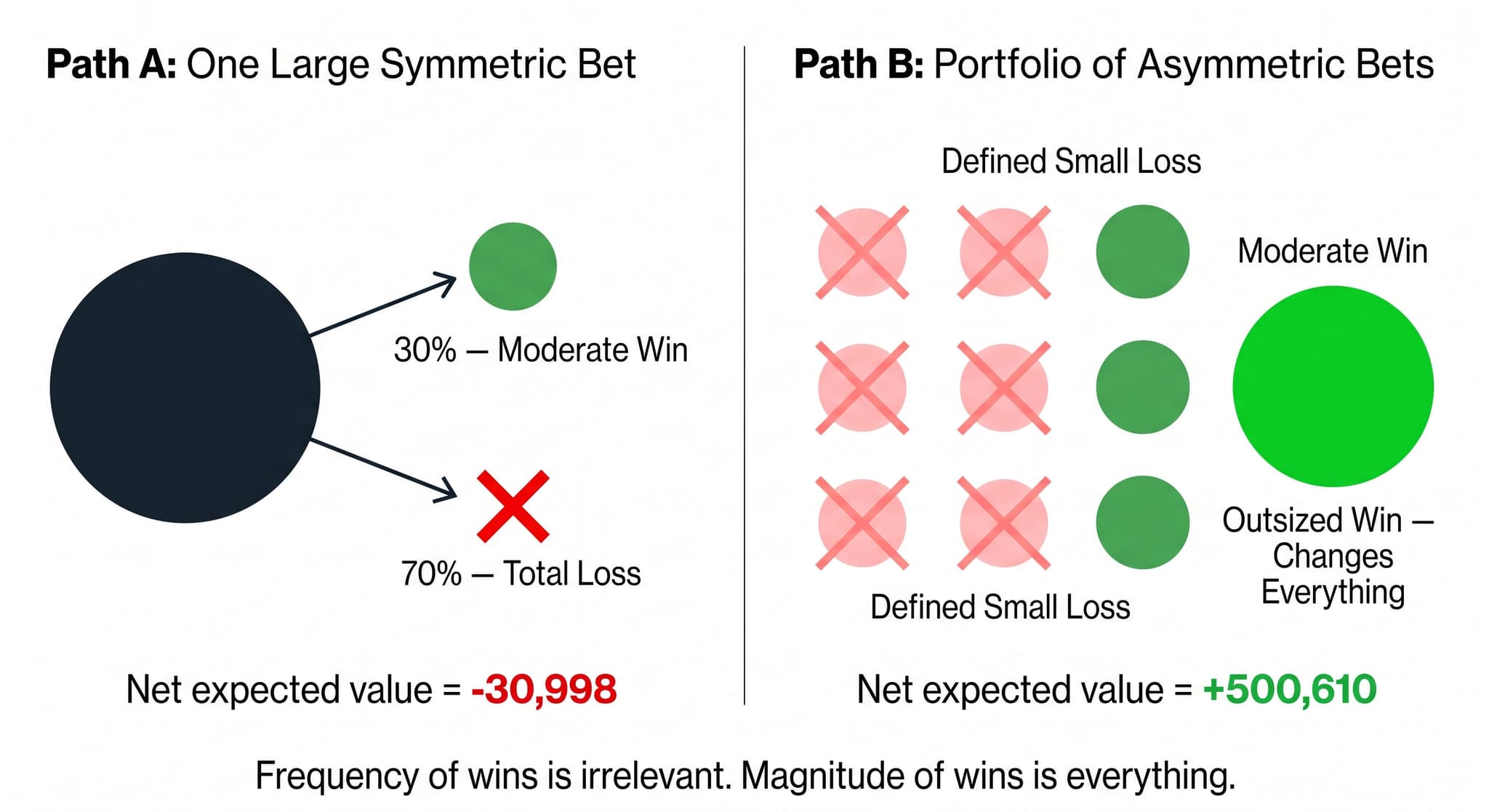
A bet with a 90 percent chance of losing is not necessarily a bad bet. If it loses, and you lose one unit. If it wins, you gain 100 units.
Most people will not take it, and most people who take it once will not take it repeatedly when the first nine attempts fail. The discomfort of frequent small losses overwhelms the mathematical logic of an enormous expected gain.
This gap between the emotional experience of a bet and its actual mathematical structure is where asymmetric thinking lives. And it is exactly the gap that the best builders, investors, and decision-makers in the world have learned to close.
Part II - The Structure of Asymmetry
What Makes a Bet Asymmetric
Not every opportunity with a large potential upside is an asymmetric bet. The structure requires specific conditions. Understanding these conditions is what separates disciplined asymmetric thinking from mere optimism.
Condition One
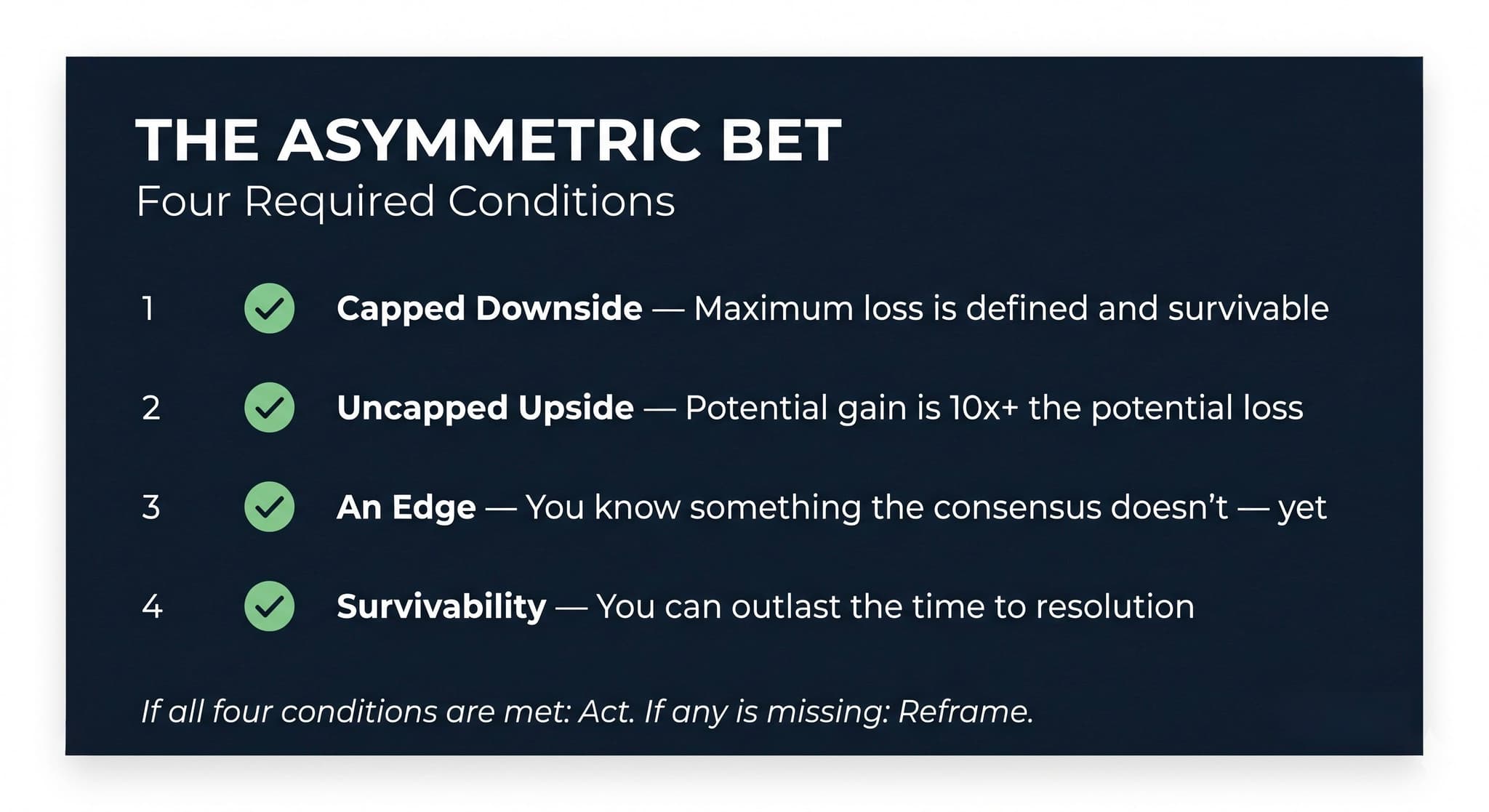
Capped Downside
The defining feature of a genuinely asymmetric bet is that the downside is limited and knowable in advance. You know the maximum you can lose before you commit. This is not just about financial exposure. It applies to time, reputation, and opportunity cost. If you cannot define and accept the maximum downside before committing, you are not making an asymmetric bet. You are making a leveraged bet, which is a very different and far more dangerous thing.
Condition Two
Uncapped or Disproportionate Upside
The upside must be either unlimited or sufficiently large relative to the downside that the expected value is significantly positive even at low probabilities of success. A bet that offers a two-to-one return is not asymmetric in any meaningful sense. The asymmetry that matters, the kind that produces compounding wealth and enduring competitive advantage, typically involves ratios of ten-to-one or higher.
Condition Three
An Information or Timing Edge
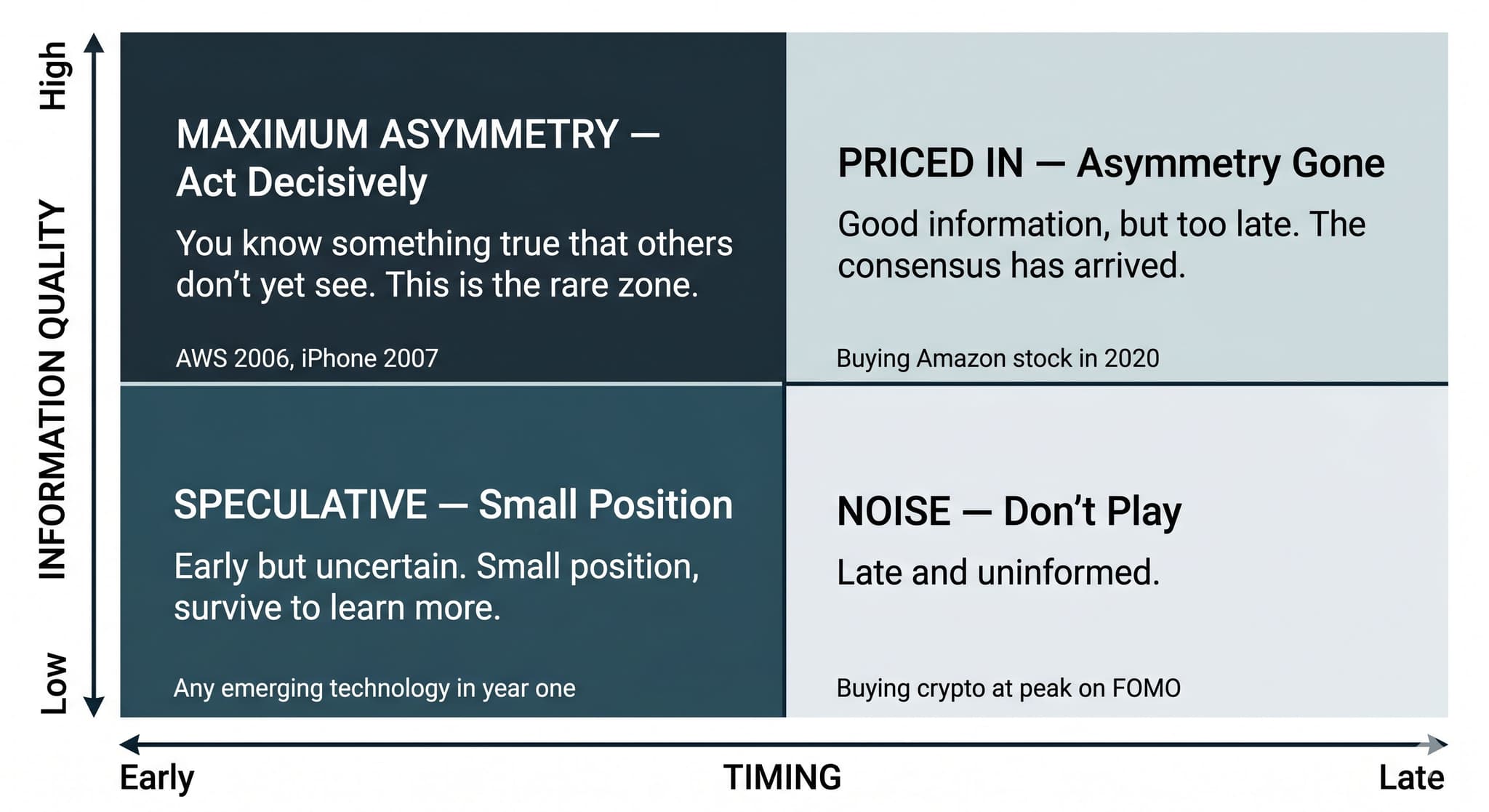
If the asymmetry is obvious to everyone, it is already priced into the opportunity. True asymmetric bets exist where the participant has an information advantage, a timing advantage, or an analytical framework that the market has not yet applied to the situation. The asymmetry exists in the gap between what you understand and what the consensus believes.
Condition Four
Survivability During the Wait
This is the condition most analyses omit. Asymmetric bets typically take longer to resolve than expected. The structure is correct, the analysis is right, and the outcome is still years away. If you cannot survive - financially, organizationally, psychologically - during the period between committing to the bet and its resolution, the bet destroys you regardless of whether it was correct.
Part III - The Historical Evidence
Four Asymmetric Bets That Defined Decades
The best way to understand asymmetric bets is not through abstract theory but through the concrete decisions of people who understood the structure and acted on it when the consensus thought they were wrong.
Amazon Web Services - 2006
Cloud InfrastructureIn 2006, Amazon was a retail company. Jeff Bezos committed significant engineering resources to building cloud computing infrastructure. The downside was defined: wasted engineering time and capital if the project failed. The upside was undefined and potentially enormous: a new business category that did not yet exist.
The consensus view at the time was that Amazon was a retailer distracting itself with infrastructure experiments. The asymmetry was invisible to observers because they were evaluating Amazon through the frame of what it was rather than what it could become.
Netflix Streaming - 2007
Self-CannibalizationIn 2007, Netflix had a profitable, growing DVD-by-mail business. Reed Hastings committed to building a streaming platform that would directly cannibalize the revenue stream funding the company's operations. The downside was explicit and severe: destroying a profitable business model before the replacement was ready.
Hastings said at the time that if Netflix did not cannibalize itself, someone else would. The question was not whether streaming would replace physical media. The question was whether Netflix would be the company that survived the transition or the company that the transition destroyed.
The PayPal Mafia - 2002 to 2004
Portfolio AsymmetryWhen PayPal was acquired by eBay in 2002, every significant member of that team took their proceeds and made asymmetric bets with them. Not one each, but multiple simultaneously. Elon Musk invested in Tesla and SpaceX. Peter Thiel wrote the first outside check to Facebook. Reid Hoffman founded LinkedIn.
The individual bets looked speculative. The collective pattern was systematic asymmetric thinking applied by people who had learned through the PayPal experience that the consensus is frequently wrong about transformational companies in their early stages.
The Apple iPhone - 2007
Category CreationWhen Steve Jobs announced the iPhone, Apple was a music and computer company with a market capitalization of approximately $74 billion. The iPhone required Apple to cannibalize the iPod, its most profitable product, and enter a market dominated by established players with superior distribution and carrier relationships.
Jobs described the decision simply: if Apple did not make this bet, someone else would make a similar product and Apple's position in consumer electronics would erode regardless.
Part IV - The Frequency Error
Why Being Right Most of the Time Is Not the Goal
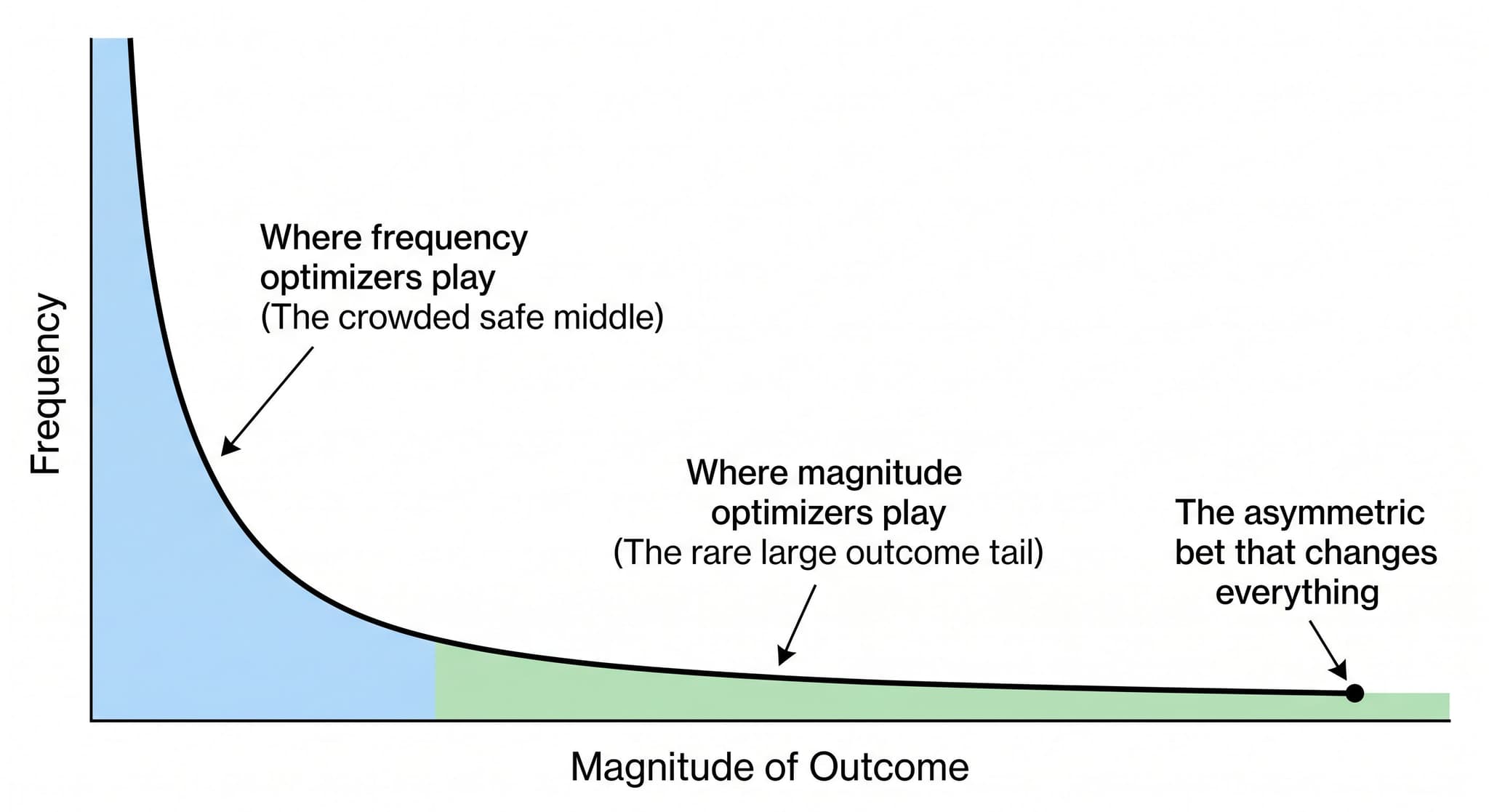
The most persistent obstacle to asymmetric thinking is the frequency error: the deeply human tendency to evaluate decisions based on how often they produce a positive outcome rather than on the expected value they generate.
The frequency error is not irrational in the environments that shaped human psychology. When our ancestors were making decisions about where to find food or whether a predator was nearby, frequency of correct outcomes was the right metric. Being wrong once about a predator was potentially terminal. High frequency of correct calls was survival.
The problem is that this psychological framework, optimized for environments where individual errors could be catastrophic, is actively harmful when applied to asymmetric opportunity evaluation. In asymmetric environments, the rare large-magnitude win is what matters. Optimizing for frequency of wins means systematically avoiding the bets that produce the large-magnitude outcomes.
“The top six percent of investments generate sixty percent or more of total fund returns. The remaining ninety-four percent of portfolio companies are largely irrelevant to the fund's performance.”
The venture capital industry understands this structurally. A venture capitalist who optimized for portfolio success rate, picking only companies they were highly confident would succeed, would systematically exclude the investments that produce outlier returns. Outlier returns require outlier bets. Outlier bets look risky, uncertain, and frequently wrong by the standards of conventional evaluation.
Part V - Where Asymmetric Bets Actually Exist
A Practical Map
Asymmetric bets are not randomly distributed across life and business. They concentrate in specific structural conditions. Understanding where to look is as important as understanding the framework itself.
In Career and Skill Development
The most underappreciated asymmetric bets available to most people are in skill acquisition. Learning a skill that is both rare and valuable has a capped downside (the time and effort invested) and an uncapped upside, because rare and valuable skills compound in ways that are impossible to predict in advance.
The key word combination is rare AND valuable. A skill that is rare but not valuable produces no asymmetry. A skill that is valuable but not rare is priced at its market rate with no asymmetric premium. The asymmetry exists at the intersection.
In the current environment, the most asymmetric skill combinations sit at the intersection of technical depth and strategic communication: people who can build complex systems and explain them to decision-makers. This combination is genuinely rare and disproportionately rewarded.
In Business Model Architecture
Not all revenue is created equal. A business that generates one million dollars in revenue from hourly consulting has fundamentally different economic characteristics than a business that generates one million dollars from software subscriptions. The consulting revenue is linear, symmetric, and non-compounding. The subscription revenue is convex, asymmetric, and compounding.
Every significant technology company is built on this architectural asymmetry. The infrastructure investment is the defined downside. The distribution potential is the uncapped upside.
In Information and Timing
Information asymmetry, knowing something that the market does not yet know, creates temporary asymmetric betting opportunities. The challenge with information-based asymmetric bets is that the window is always closing. As information diffuses through markets and institutions, the asymmetry erodes. The value of being early is precisely that the consensus has not yet arrived.
This is why disciplined practitioners invest heavily in original research. The research produces information before the market has it. That information creates temporary windows of asymmetric opportunity.
Part VI - The Mistakes
How Intelligent People Misapply This Framework
Understanding asymmetric bets does not automatically produce good asymmetric betting. There are several systematic errors that intelligent people make when applying this framework.
Mistake One: Calling Every Optimistic Bet Asymmetric
A bet is not asymmetric simply because the upside is large. It is asymmetric when the downside is genuinely limited and defined relative to the upside. If the downside is existential, the bet is not asymmetric regardless of the potential upside. The test is simple: can you describe the maximum downside precisely and accept it completely before committing? If the answer is no, you are not making an asymmetric bet. You are gambling.
Mistake Two: Ignoring Position Sizing
Even a structurally asymmetric bet produces poor outcomes if the position size is wrong. The Kelly Criterion provides the mathematical framework for optimal position sizing. The core insight: even with positive expected value, overbetting leads to ruin because the compounding effect of losses exceeds the compounding effect of wins at excessive position sizes.
Mistake Three: Failing the Survivability Requirement
The most common practical failure of asymmetric bets is not analytical error. It is running out of time before the bet resolves. The structure is correct. The analysis is sound. The outcome is still three years away. And the resources required to survive those three years were not adequately provisioned.
Mistake Four: One Asymmetric Bet at a Time
Asymmetric bets are portfolio strategies, not individual decision strategies. The expected value of a single asymmetric bet with a ten percent probability of success is positive, but the most likely outcome of any single bet is still failure. The mathematical advantage of asymmetric thinking only manifests at scale, across multiple bets, over time.
Part VII - The Second Order Insight
What Goes Beyond It
Applied to asymmetric bets, the second-order insight is this: if an asymmetric bet is obvious to you, it is probably obvious to others. And if it is obvious to others, it is already priced.
The bets with the most genuine asymmetry are the ones that look wrong to the consensus at the time of making them. Amazon AWS looked like a distraction. Netflix streaming looked suicidal. The iPhone looked like overreach. Significant enterprise software platforms built by teenagers in dorm rooms looked like hobbies.
“The discomfort of the consensus view is not proof that a bet is right. Contrarian bets that look wrong to the consensus are usually wrong. But the bets with the most asymmetric payoffs almost always look wrong to the consensus at the time of commitment, because if they looked obviously right, the asymmetry would already have been arbitraged away.”
This creates an uncomfortable implication: if your asymmetric bet feels comfortable and widely validated, examine whether the asymmetry you think exists has already been priced in.
The genuine asymmetric bet feels lonely. It requires acting on your own analysis in the face of consensus skepticism. It requires trusting your framework more than you trust the market's current assessment.
This is psychologically difficult in a way that no framework can fully address. It is the reason that understanding asymmetric bets intellectually is not sufficient. The practice requires building the psychological infrastructure to act on analysis that contradicts consensus: repeatedly, over time, in the face of the frequent failure that is an inherent feature of asymmetric betting strategies.
Conclusion - The Only Question That Matters
Every significant decision a builder, executive, or investor makes is either a symmetric bet or an asymmetric one. The choice is rarely explicit. It is usually embedded in how the opportunity is framed, how the downside is defined, and how the position is sized.
The discipline of asymmetric thinking is not about taking more risk. It is about taking the right risks, the ones where the structure of the payoff justifies the probability of failure, and sizing those risks in a way that preserves the ability to make the next bet.
The people who build enduring things are not the ones who are right most often. They are the ones who have built the analytical and psychological infrastructure to identify, commit to, and survive asymmetric bets. Repeatedly, over long periods, in the face of frequent failure and consensus skepticism.
The goal is not to win every bet. The goal is to be in the game long enough for the mathematics of asymmetry to work in your favor.
Frequency is the wrong metric. Expected value is the right one.