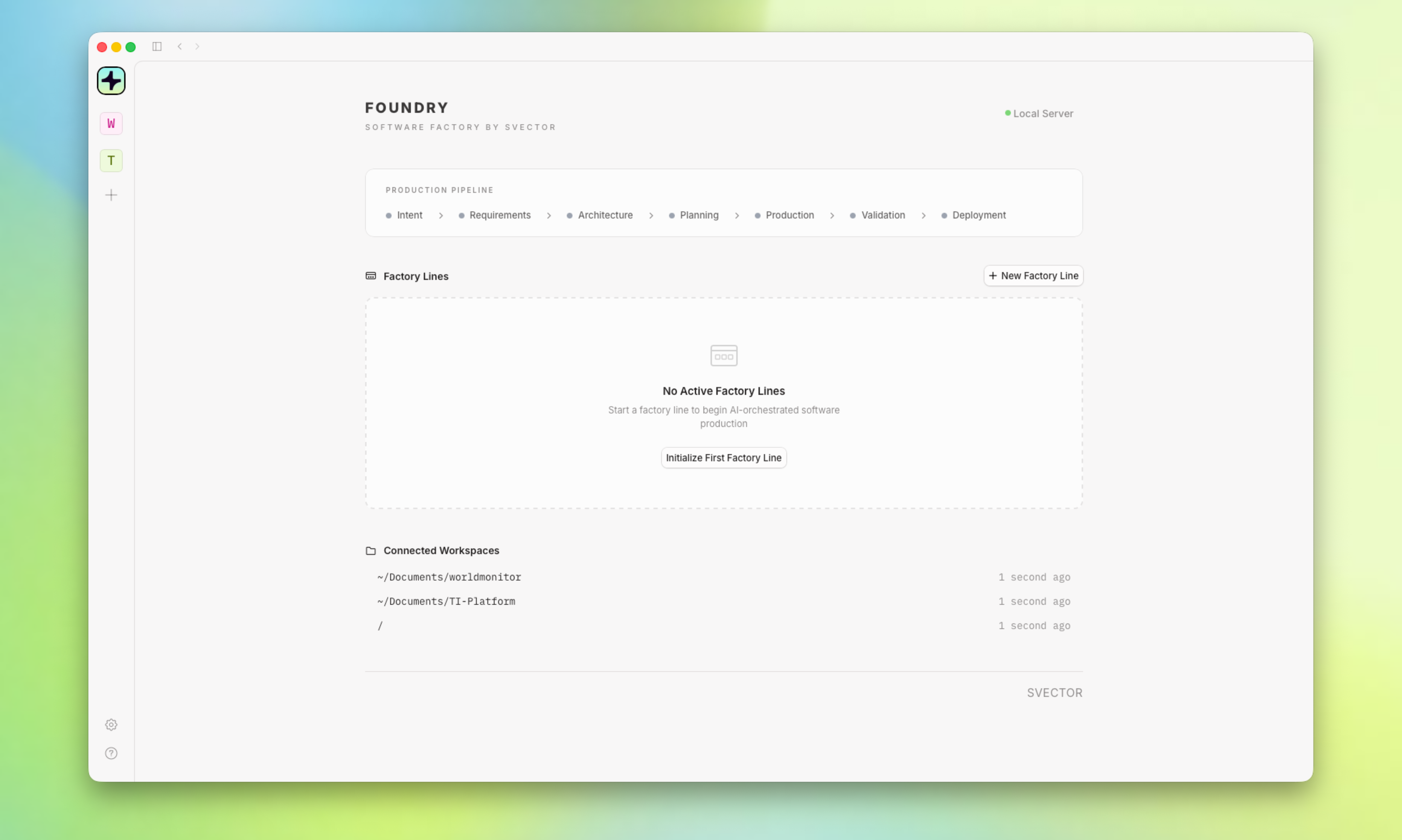
Foundry manages the entire development lifecycle from a single natural language description. Your input is a business problem. Your output is production-ready software running inside your infrastructure - with no developer handoffs in between.
It's not an engineering problem. It's the cost of translating business intent into working code through layers of human handoffs - each one adding time, error, and budget overrun.
Mid-size enterprises spend $250,000 - $1,250,000 annually on software that arrives late, over budget, and underspecified. The root cause is translation friction, not engineering talent.
Every AI coding tool routes operations through external providers - their pricing sets your margin ceiling and your data crosses their infrastructure.
Projects take 6-18 months. Markets and regulations move faster. Software is often obsolete before it ships.
Human teams produce variable output. The same business requirement rarely produces the same architecture twice - compliance requirements interpreted differently each time.
Foundry manages the entire development lifecycle from a single natural language description. Your input is a business problem. Your output is production-ready software running inside your infrastructure - with no developer handoffs in between.
You describe the business problem - not the solution. Foundry extracts implicit requirements, resolves dependencies, and constructs a formal architecture before writing a single line of code.
Requirements, architecture, build, test, self-correction, validation, deployment - Foundry owns the entire chain. The output is running software in your infrastructure, not fragments for a developer to assemble.
Every deployment runs inside your own environment - on-premise, hybrid, or private cloud. No SaaS lock-in. No data crossing external systems. Full sovereignty from day one.
One sentence: build a HIPAA-compliant hospital billing platform. What follows is the actual Foundry output - no cherry-picking, no developer intervention on any core task.
foundry › Build a HIPAA-compliant hospital billing platform. Full stack. Postgres, REST API, admin dashboard.
─── Pass 1: Intent decomposition ────────────────────
✓ 14 core modules across 4 service domains
✓ HIPAA compliance mapped - PHI isolation confirmed
✓ Data flow architecture - 0 circular dependencies
─── Pass 2: Execution planning ──────────────────────
✓ 47 tasks parallelized across 6 execution lanes
✓ Critical path: schema → API → auth → UI → audit → deploy
→ Production begins
Foundry works like a factory: raw input enters, finished product exits. Your input is a business problem. Your output is production software running inside your infrastructure - no handoffs, no meetings, no delays.
Every SVECTOR product was built using Foundry. It is not a prototype - it is the system that manufactures our own software portfolio.
The bottleneck in enterprise software isn't engineering intelligence - it's the speed at which requirements get translated into working code. Foundry eliminates that translation layer entirely. Your developers focus on decisions that require human judgement - not months of implementation groundwork.
Bring your PRD. Foundry builds exactly what it says - inside your infrastructure, to your standards, on a timeline your business can actually use.
Foundry integrates into your existing operations - no disruption, no replacement, no compromise.
Foundry rebuilds on a modern foundation - existing behaviour preserved, timeline cut from years to weeks.
Built from first principles to the standards your risk, compliance, and operations teams demand.
Foundry builds to your exact specification - precision and reliability enforced from the first line of code.
Built and deployed entirely within your infrastructure. Auditable at every layer. Nothing outside your control.
Most software tools help developers write code faster. Foundry removes the developer from the core build loop entirely - replacing months of implementation work with hours of autonomous execution.
Other tools generate code snippets. Foundry generates working software - requirements, architecture, build, tests, and deployment handled end-to-end. You get a running system, not raw material for your engineering team to assemble.
When Foundry hits an error during a build, it diagnoses and fixes it autonomously. No tickets raised. No engineer pulled in. The self-correction loop runs inside the build pass, not after delivery.
Foundry deploys into your own infrastructure - on-premise, private cloud, or hybrid. Nothing about your business problem, your codebase, or your users ever reaches an external system.
Every project Foundry completes inside your environment produces structured feedback that improves subsequent builds. The system learns what your organisation builds and how - getting faster and more precise over time.
Every company already has the ideas. The problem was never imagination. It was the friction between knowing and building. When that friction disappears, software stops being a bottleneck and becomes the default way companies operate.
Siddharth Shah - Founder & CEO, SVECTOR