
The Thesis
The market is building faster machines for organizations that have not yet learned how to remember. Models are improving. Agents are multiplying. Data is accumulating. Workflows are becoming automatic. Yet the central institutional weakness remains untouched: after a consequential decision produces a result, most organizations cannot reconstruct the judgment that made the decision possible.
They can recover the approval, but not the belief. They can recover the dashboard, but not the uncertainty. They can recover the meeting, but not the strongest rejected alternative. They can recover the outcome, but not the confidence that preceded it. The organization stores activity and discards causality.
That missing chain is becoming the most important competitive asset in the modern enterprise. Decision memory is the capacity to preserve what was known, what was believed, what was chosen, who accepted the consequence, what reality produced, and how the institution changed afterward. It is not another archive. It is the mechanism by which experience becomes calibrated judgment.
“Most companies are not learning organizations. They are storytelling organizations.”
They become increasingly sophisticated at explaining the past without becoming materially better at confronting the future.
The claim of this memo is deliberately narrow. The method is not proprietary. Any institution can begin tomorrow. The advantage comes from time, honesty, and continuity. A competitor can copy a template. It cannot retroactively acquire ten years of beliefs linked to outcomes, overrides linked to consequences, and mistakes linked to genuine updates. The moat is not secrecy. The moat is accumulated calibration.
01 — The Most Valuable Asset Is Thrown Away
Every consequential decision produces two outputs. The first is visible: capital moves, a person is hired, software is deployed, a plant is expanded, a market is entered, a threat is escalated, or a policy is changed. The second output is usually discarded: a labeled example of how the institution reasoned under uncertainty.
That second output can be more valuable than the first. The action may create one result. The record of the action can improve hundreds of future decisions. Yet most organizations preserve the transaction and lose the judgment. They spend heavily to capture what moved, then almost nothing to capture why they believed movement was justified.
This is not a technology failure. It is a design failure. Enterprise systems were built around the objects that operations could count: customers, invoices, employees, contracts, assets, incidents, tasks, and messages. The decision itself never became a first-class object. It remains scattered across decks, meetings, chats, private memory, and the political reconstruction that follows success or failure.
When the people leave, the reasoning leaves. When the outcome arrives, the original uncertainty disappears. When accountability becomes uncomfortable, the institution discovers that its records are detailed enough to prove activity and weak enough to prevent learning.
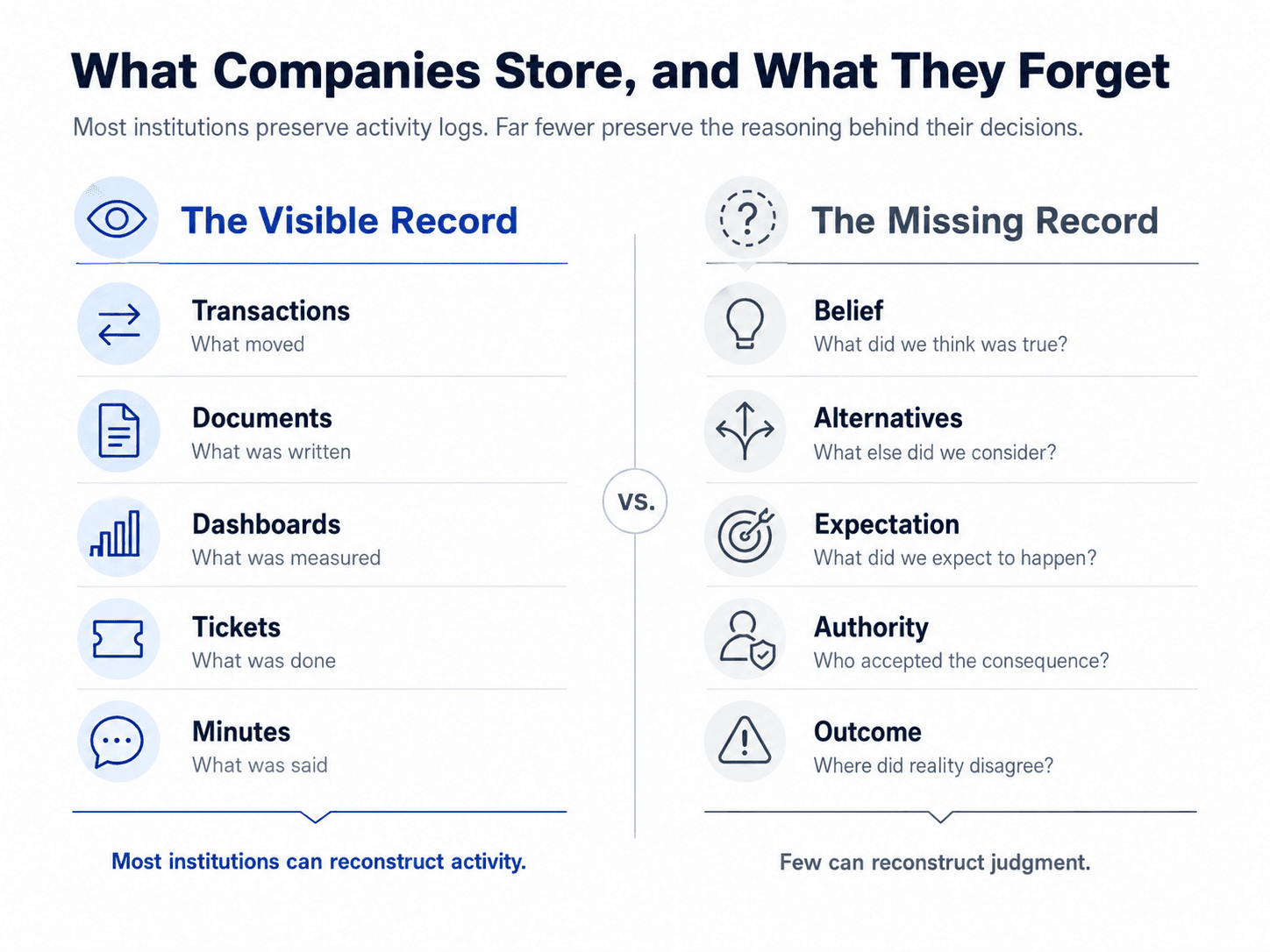
Figure 1. Decision memory preserves the lineage from evidence to update, including the competing view that execution normally erases.
02 — The Age of Cheap Intelligence
For the last decade, strategic advantage has been discussed as a contest for models, data, compute, distribution, and workflow access. Each matters. None will remain scarce in the same way.
Model capability is diffusing rapidly. Techniques that once required a research institution can now be rented through an interface. Data remains valuable, but much of it can be purchased, licensed, scraped lawfully, reconstructed, or generated through customer interaction. Workflow integration creates real switching costs, but competitors can eventually reproduce the visible process.
Decision memory has a different economic shape. Its value depends on a sequence that cannot be compressed. The institution must make a decision before the outcome is known. It must preserve the original state honestly. Reality must unfold. The outcome must be measured. The original belief must be compared with the result. The update must alter the next decision. Then the cycle must repeat for years.
There is no shortcut because the asset is not a static corpus. It is the relationship between this institution, these conditions, these people, these models, these overrides, and these consequences. It is causal texture accumulated through time.
“Models can be rented. Data can be bought. Judgment cannot be imported in bulk.”
It has to be earned through repeated exposure to reality, then preserved without allowing power to rewrite the record.
03 — The Missing Object in Enterprise Software
A decision is not a meeting. It is not an approval. It is not a recommendation. It is not a task changing status. A decision is a time-bound commitment under uncertainty that transfers authority into consequence.
Most systems capture fragments of this object. Workflow software records who approved. Analytics records what was measured. Communication tools record what was said. Model logs record what computation occurred. None of these alone can answer the question that matters after the result: why did the institution believe this action was justified at that time?
The absence of the decision object creates a structural blindness. A board can see that a project failed but cannot determine whether the original decision was reckless, reasonable, unlucky, politically distorted, or correct under the information then available. A hiring committee can see that an executive left after nine months but cannot test which predicted operating pattern failed. A risk team can see an adverse event but cannot trace which weak signal was dismissed, which competing hypothesis was suppressed, and who accepted the residual risk.
A serious decision record therefore has to preserve both the world and the institution's model of the world. Facts, inferences, preferences, and authority must remain distinct. Otherwise a senior opinion becomes a fact, a forecast becomes a promise, an approval becomes proof, and a favorable outcome becomes evidence that the thinking was sound.
04 — Hindsight Is a Governance Failure
Human beings do not remember uncertainty faithfully. Once an outcome is known, it changes the perceived likelihood of what happened and the apparent relevance of the evidence that preceded it. Classic research on hindsight bias showed that people overestimate what they would have known before the result. Later research has confirmed that favorable outcomes also make the same underlying decision appear more competent than unfavorable outcomes do.[1][2]
Institutions multiply this distortion. Status determines which memory receives airtime. Incentives determine which uncertainty is emphasized. Legal exposure determines which sentence survives. The successful sponsor remembers conviction. The failed sponsor remembers caution. The dissenting team remembers clarity. The organization does not simply misremember. It reorganizes the past around the present distribution of power.
This is why most postmortems are weaker than they appear. They are written after the verdict, using evidence that has already changed meaning. Without a frozen pre-outcome record, a retrospective can explain a failure without proving what anyone actually believed before the failure occurred.
“A board that cannot reconstruct the original uncertainty is not governing the decision. It is merely grading the result.”
The pre-decision record must therefore be tamper-evident. It may be amended, but not silently replaced. New evidence may be appended, but the original confidence, dissent, constraints, and expectations must remain visible. This preserves the difference between foresight and hindsight, between disciplined risk-taking and luck, and between accountability and retrospective theater.
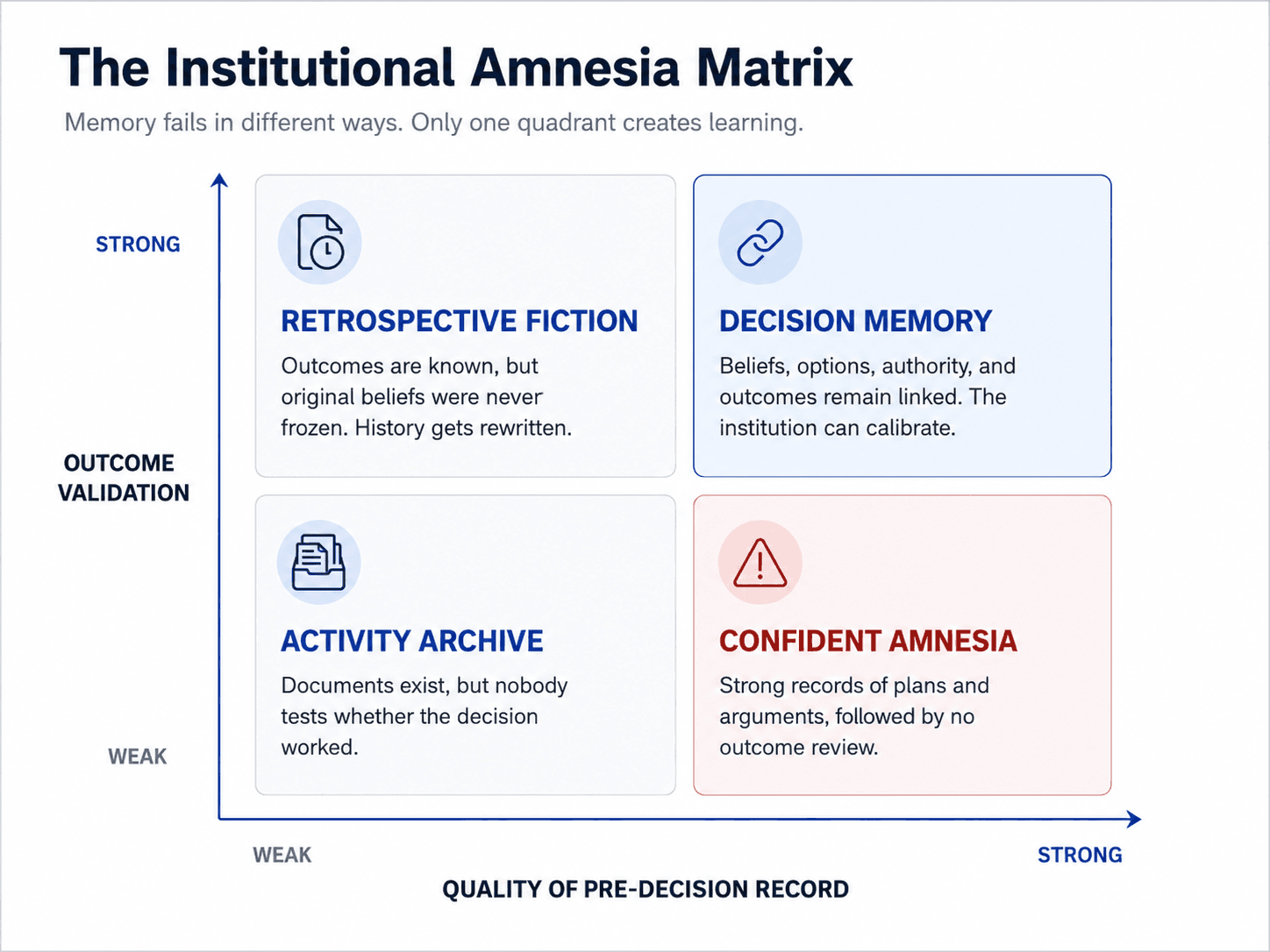
The Institutional Amnesia Matrix. Memory fails in different ways. Only one quadrant creates learning.
05 — Decision Quality Is Not Outcome Quality
A good outcome can come from a bad decision. A bad outcome can come from a good decision. Any institution that cannot hold both statements at once will gradually destroy honest judgment.
When leaders are rewarded only for outcomes, they learn to hide uncertainty and avoid defensible risks. When failure is punished without examining the original information set, teams stop stating probabilities and start manufacturing certainty. When success is treated as proof of wisdom, luck acquires authority.
Decision memory separates the quality of reasoning from the quality of the result. It asks whether the question was properly framed, whether material evidence was considered, whether dissent was preserved, whether confidence matched evidence, whether the chosen action was proportional, and whether the responsible authority understood the consequence. The later outcome remains essential, but it becomes evidence for calibration rather than a verdict on character.
This distinction is central to high-stakes institutions. Aviation safety, site reliability engineering, medicine, intelligence, capital allocation, and industrial operations all confront uncertain systems where sound decisions can still produce adverse results. The purpose of memory is not to eliminate surprise. It is to become less surprised by the same mechanism twice.
06 — What Decision Memory Actually Contains
A usable decision memory is concise enough to influence action and complete enough to survive later scrutiny. It contains eight elements:
01 - Mandate
The exact decision question, deadline, scope, and accountable owner.
02 - Context
The state of the world at the time, including incentives, constraints, dependencies, and time pressure.
03 - Evidence
The sources available, their timestamps and reliability, the contradictions, and what remained unknown.
04 - Competing Views
The strongest alternative explanation or course of action, including the evidence that could make it correct.
05 - Expectation
The predicted outcome, time horizon, confidence, and explicit conditions under which the decision should be judged wrong.
06 - Authority
The person or body authorized to decide and the person or body accepting the consequence.
07 - Outcome
What actually happened, including second-order and unintended effects.
08 - Update
Which belief changed, which signal gained or lost weight, and what policy, threshold, model, or future question must change.
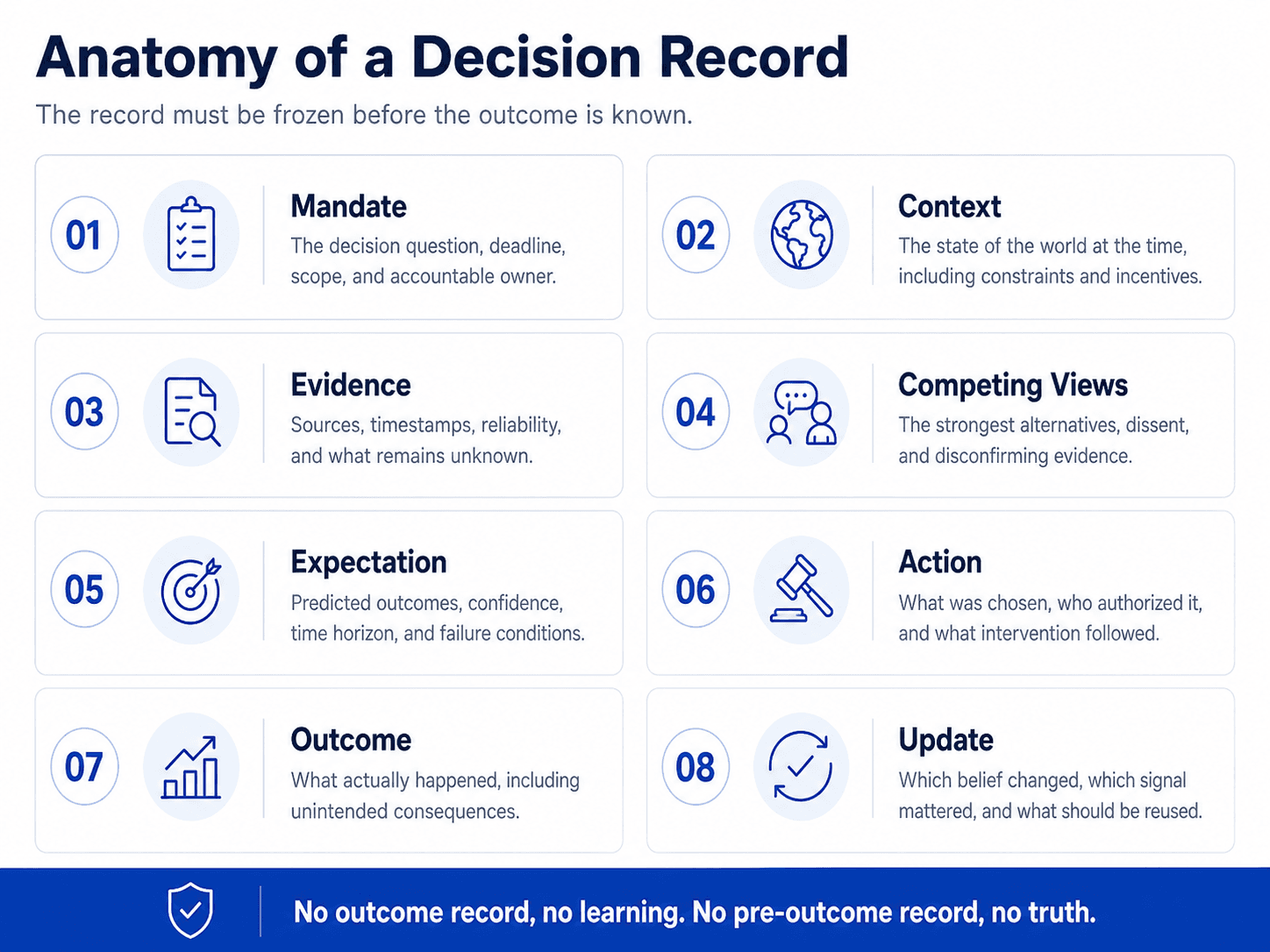
Figure 2. The decision record has a pre-outcome half and a post-outcome half. Both are required.
This record is not a transcript. Transcripts preserve language without hierarchy. It is not a knowledge base. Knowledge bases preserve reusable information without the pressure of a specific choice. It is not a model log. Logs preserve computation without institutional authority. Decision memory joins evidence, judgment, power, and consequence in one time-aware object.
07 — The Moat Is Temporal, Not Technical
The phrase “cannot be copied” is used too casually in technology. Almost every visible feature can be copied. A competitor can build the same form, adopt the same review process, and purchase similar tools. The defensible advantage begins only after repeated use creates information that did not exist before the institution acted.
Over time, the organization learns which teams are well calibrated, which signals repeatedly mislead, which overrides improve performance, which confidence ranges are honest, which customer conditions reverse an apparently similar case, and which failure mechanisms recur across departments under different names. This is not generic best practice. It is a map of the institution's own judgment.
A new entrant can start the practice immediately. It cannot know what the incumbent has learned about itself. It cannot reconstruct unrecorded beliefs from five years earlier. It cannot acquire a history of how particular leaders reason under pressure, how specific models fail in local conditions, or how certain operating constraints change the meaning of familiar signals.
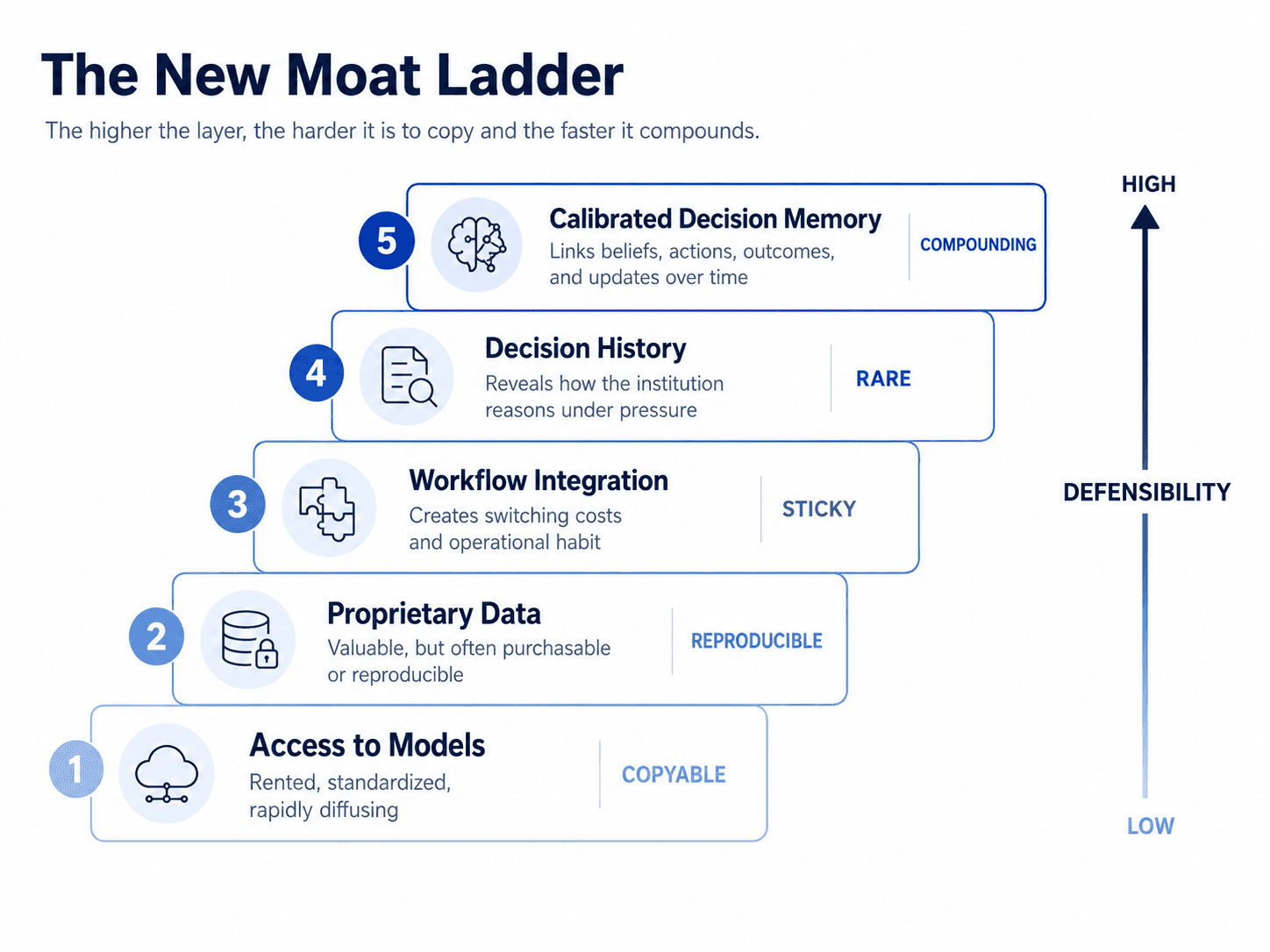
Figure 3. The strategic value of model access tends to diffuse. Decision memory deepens only through sustained use and honest outcome linkage.
The advantage is also fragile. If the institution stops reviewing outcomes, lets politics rewrite records, or treats the system as documentation rather than adaptation, the moat stops compounding. Decision memory is not possessed once. It is renewed through discipline.
08 — Artificial Intelligence Will Industrialize Amnesia
Artificial intelligence makes this issue urgent because it dramatically increases the production of recommendations, rationales, forecasts, rankings, and actions. It can also produce polished explanations that look more complete than the underlying evidence deserves.
Without decision memory, the AI-enabled institution will confuse computational traceability with accountability. Technical logs may show which model version ran, which prompt was used, and which tools were called. They do not automatically show why the institution accepted the objective, what alternatives were considered, whether a human challenged the output, who authorized the downstream action, or what consequence the institution was willing to accept.
NIST's AI Risk Management Framework emphasizes continuous governance, mapping, measurement, management, documentation, and clearly defined responsibilities across the AI lifecycle.[3] The underlying principle is broader than compliance: trustworthy autonomy requires a record of how power moved from data to action.
“The important question is not whether the machine can explain its output. It is whether the institution can explain its decision without allowing the machine to write the history after the fact.”
AI also creates a new form of retrospective fraud. After an adverse outcome, the same system that generated the recommendation can generate a persuasive explanation for why the recommendation appeared reasonable. Unless the pre-outcome state was frozen, the institution may accept a machine-generated alibi as evidence of prior judgment.
The result will be organizations that act at machine speed and learn at political speed. They will automate execution while leaving memory vulnerable to status, convenience, and narrative. This is not intelligent automation. It is accelerated institutional amnesia.
09 — Memory Changes Power
Decision memory is often described as a learning system. It is also a constitutional system. It changes who can define reality inside the organization.
In an institution without a trustworthy record, the most senior surviving narrative wins. The person with authority can claim that the risk was unforeseeable, the warning was weak, the assumption was shared, or the result was caused by execution. The original uncertainty has vanished, so political power becomes historical power.
A frozen record raises the cost of revisionism. The forecast remains visible. The dissent remains visible. The confidence remains visible. The override remains visible. The institution can compare the story told after the result with the reasoning recorded before it.
This does not eliminate politics. Nothing does. It disciplines politics with evidence. It makes confidence expensive, because confidence can later be calibrated. It makes dissent useful, because dissent can later be tested. It makes overrides legitimate, because the person who exercises authority leaves a reason that can be compared with the outcome.
The cultural effect is profound. People become more precise about what they know. They state what would change their view. They distinguish disagreement from disloyalty. They become less eager to erase uncertainty for the sake of executive comfort.
10 — The Two Loops
Every institution uses the past. The question is what it uses the past to produce.
The amnesia loop begins with an event, produces a narrative, adds a control, and returns to action. It is efficient, familiar, and often useless. The control may reduce one visible symptom while leaving the underlying belief untouched. The same failure later returns through another channel.
The learning loop begins with a recorded decision, measures the outcome, calibrates the original belief, and updates the operating model. The update may change a threshold, a playbook, a model, a role definition, a governance rule, or the question asked next time. The loop is complete only when the institution behaves differently.
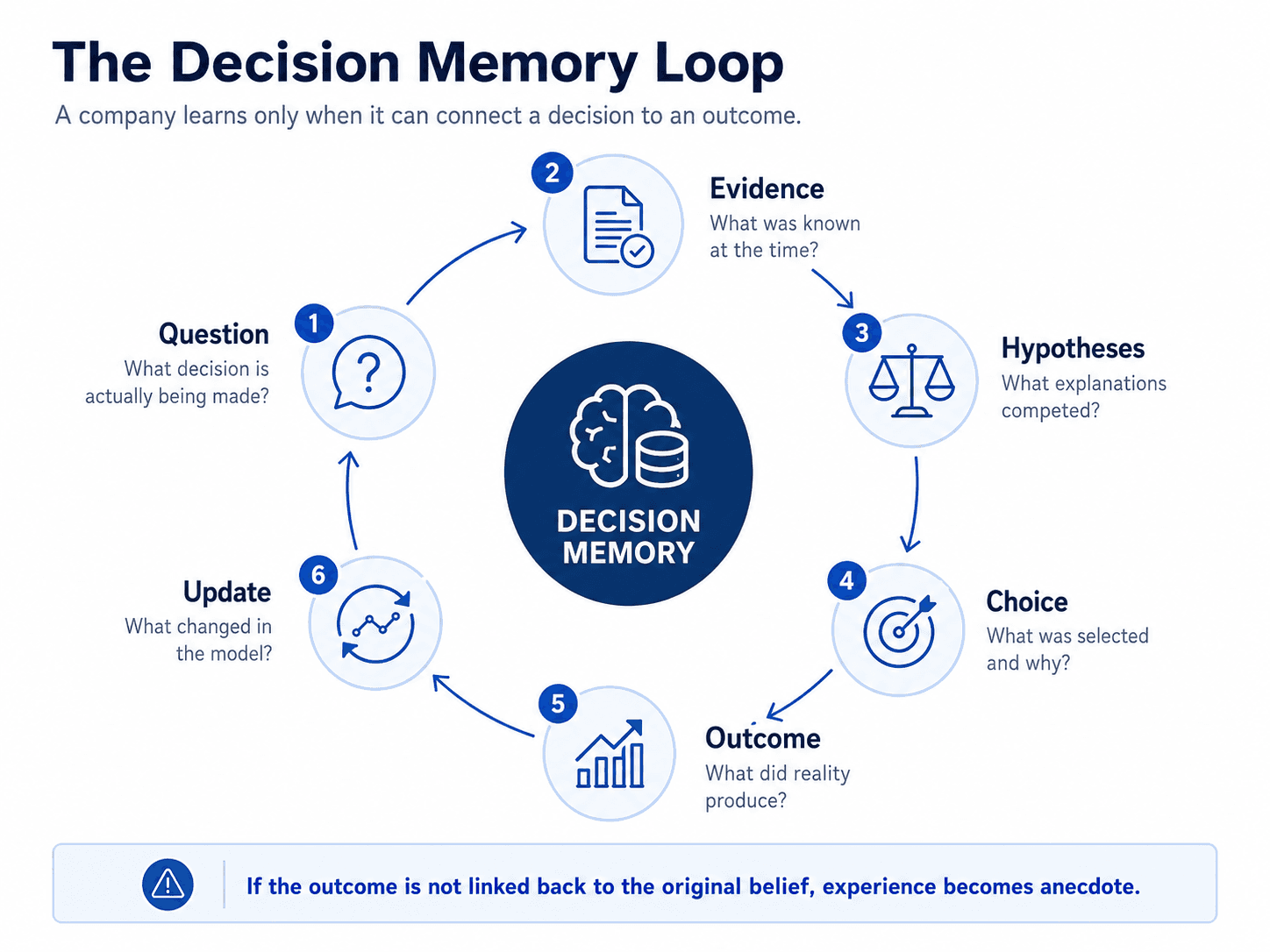
Figure 4. Explanation closes the incident. Calibration changes the institution.
NASA's Aviation Safety Reporting System demonstrates the power of designed memory. By 2026, it had received more than 2.3 million voluntary and confidential reports over fifty years, with more than 350 reports arriving each day. The reports are de-identified, analyzed, and used to surface patterns and prevent recurrence.[4] The system works not because aviation professionals were told to remember better, but because reporting, protection, analysis, and dissemination were designed as an operating mechanism.
Google's site reliability guidance follows the same principle: incidents become valuable only when postmortems are written, shared, and converted into follow-up action that reduces recurrence.[5] The record matters because it changes the system, not because it proves that a meeting occurred.
11 — The Right to Forget
A serious memory system cannot be built on the fantasy of permanent, universal recall. Some information should not remain available forever. Some identities require protection. Some deliberations are legally privileged. Some operational details create security risk. Some historical judgments become dangerous when detached from the conditions that produced them.
Organizational research has shown that forgetting is not merely failure. It can remove obsolete routines and permit adaptation.[6] The design challenge is therefore not perfect retention. It is legitimate retention.
Decision memory should include purpose limitation, role-based access, de-identification, sealed records, retention schedules, and clear separation between learning and punishment. A safety report should be available to the people responsible for prevention without automatically becoming a permanent weapon against the individual who disclosed it. A strategic dissent should remain testable without becoming an eternal label attached to the dissenter.
“Memory without forgetting becomes surveillance. Forgetting without memory becomes repetition.”
The institution needs enough recall to learn and enough restraint to preserve candor.
The right to forget also protects against stale authority. Historical decisions should inform the present, not rule it. The system must retain context so that an old conclusion cannot be retrieved as a timeless truth. Every record needs a date, conditions, confidence, and an explicit statement of where transfer may fail.
12 — Why Most Attempts Fail
The difficulty is not designing the template. The difficulty is keeping the practice honest after the initial enthusiasm disappears. Most attempts fail through one of six mechanisms.
1. Performative Certainty
People write the record to protect their reputation rather than expose their real belief. Confidence becomes vague and alternatives become harmless.
2. Selective Coverage
Teams classify uncomfortable decisions as routine, while recording decisions expected to look good. The archive becomes a curated success story.
3. Outcome Drift
The review date arrives, but nobody measures the original expectation precisely. The result is discussed without being graded.
4. Punitive Calibration
The system becomes an individual scorecard. People respond by hedging, hiding dissent, and refusing to make falsifiable predictions.
5. Documentation Excess
Every action is recorded. The cost of memory exceeds its value, and operators learn to copy language without thinking.
6. Ceremonial Updates
A postmortem is completed, but no threshold, policy, model, playbook, or allocation changes. The organization records learning without learning.
The mitigations are structural. Define materiality thresholds before cases arise. Freeze records with auditability. Review calibration at team level before using individual metrics. Separate honest error from negligence. Sample the archive for omitted decisions and quiet edits. Require every review to name the system change, the owner, and the completion date.
A decision memory system that cannot survive adversarial incentives is not a moat. It is a liability with excellent branding.
13 — The Operating Architecture
The architecture has four motions. First, capture the decision before the outcome. Second, review the outcome against the frozen expectation. Third, calibrate recurring patterns across decisions. Fourth, institutionalize the update by changing how future choices are made.
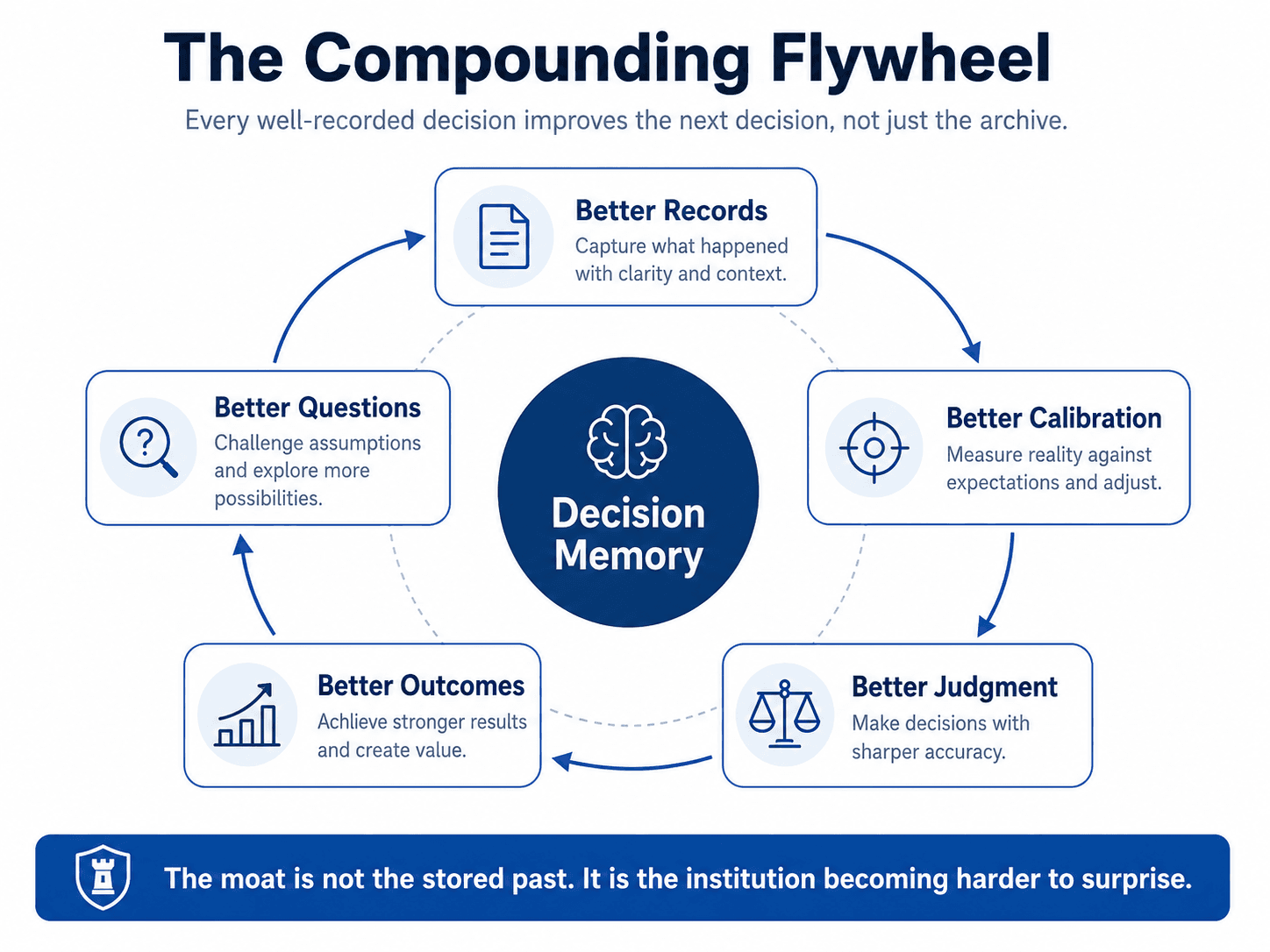
Figure 5. Decision memory becomes valuable only when the lesson changes an operating system, not merely a document.
This architecture should sit across existing systems rather than replace them. Documents provide evidence. Workflows provide timestamps and authority movement. Model logs provide computation. Operational systems provide outcomes. Decision memory links these fragments around the choice that transferred authority into consequence.
The core technical requirements are modest compared with the governance requirements: unique decision identifiers, versioned evidence, immutable or tamper-evident snapshots, explicit hypothesis and confidence fields, named authority, scheduled outcome review, access controls, and queryable links between similar decisions. The difficult requirement is organizational: people must state what they believe before they know whether belief will be rewarded.
Decision provenance research has argued that tracing the pipelines of inputs, decisions, actions, and downstream effects can improve oversight and accountability in complex algorithmic systems.[7] Decision memory extends that principle beyond technical provenance. It records not only what flowed through the system, but how discretion was exercised and how the institution revised itself after the consequence.
14 — Begin With One Hundred Decisions
The first implementation should not be enterprise-wide. Large programs fail because they begin with universal architecture before proving that anyone will use the memory to change a real decision.
Select one recurring class of consequential choice. It should be important enough to matter, repeated often enough to create a pattern, and measurable within a useful time horizon. Executive hiring, major customer credit, capital approval, product launch, model deployment, safety incident response, and supplier concentration decisions are suitable starting points.
Capture the next one hundred decisions in that class. Do not build a grand taxonomy first. Use a strict minimum record: question, evidence, strongest alternative, expectation, confidence, owner, outcome date, and update. Then examine what the institution learns about itself.
The first valuable outputs are unlikely to be sophisticated predictions. They will be uncomfortable patterns: a team that is accurate but systematically overconfident, a signal that appears in every deck but predicts nothing, an override that improves outcomes only under certain conditions, a failure mode that crosses product lines, or a review process that repeatedly changes language without changing policy.
Only after the loop changes decisions should the institution invest in enterprise search, analog retrieval, calibration dashboards, automated evidence capture, and model-assisted review. Software should scale a discipline that already works. It should not simulate a discipline the institution has not earned.
15 — The New Competitive Hierarchy
The first generation of enterprise software digitized records. The second connected workflows. The third added prediction. The next generation will determine whether institutions can remember the judgment behind action.
At the bottom of the hierarchy is access to intelligence: models, tools, data, and compute. Above it is integration: the ability to place intelligence inside real work. Above integration is decision quality: the ability to connect evidence, uncertainty, authority, and action. At the top is decision memory: the ability to learn from the relationship between belief and consequence across people, systems, and time.
The winners will not necessarily be the organizations with the most agents, the largest data estate, or the most polished dashboards. They will be the organizations least capable of lying to themselves about why they acted and fastest at converting reality into changed judgment.
“The moat is not the stored past. The moat is the institution becoming harder to surprise, harder to manipulate, and faster to correct.”
16 — The Final Test
Choose one consequential decision made two years ago. Ask the institution to reconstruct the exact question, the evidence available at the time, the strongest competing view, the expected outcome, the confidence, the accountable authority, the action taken, the actual consequence, and the belief that changed afterward.
Most organizations will recover fragments. A deck. A spreadsheet. An approval. A message. A person who remembers. The chain will not survive.
That missing chain is not a documentation problem. It is an intelligence problem. An institution that cannot reconstruct why it exercised power cannot calibrate the quality of that power. It will reward luck, punish disciplined risk, repeat hidden assumptions, and mistake explanation for learning.
Data tells the institution what happened. Analysis helps it understand what may be happening. Decision memory determines whether the institution becomes different after reality answers.
“A company that remembers its files can retrieve the past. A company that remembers its decisions can change its future.”
Everything depends on whether it preserves the truth before the outcome and has the authority to act on the lesson afterward.
Endnotes
[1] Baruch Fischhoff, “Hindsight Is Not Equal to Foresight: The Effect of Outcome Knowledge on Judgment Under Uncertainty,” originally published 1975 and reprinted in Quality & Safety in Health Care 12, no. 4 (2003): 304-311.
[2] Jonathan Baron and John C. Hershey, “Outcome Bias in Decision Evaluation,” Journal of Personality and Social Psychology 54, no. 4 (1988): 569-579; see also Sriraj Aiyer et al., “Outcomes Affect Evaluations of Decision Quality,” International Review of Social Psychology 36, no. 1 (2023).
[3] National Institute of Standards and Technology, Artificial Intelligence Risk Management Framework 1.0, NIST AI 100-1 (2023), including the Govern, Map, Measure, and Manage functions and related documentation practices. NIST announced that the framework was under revision in 2026.
[4] NASA, Aviation Safety Reporting System overview and 50th anniversary update, 2026. NASA reported more than 2.3 million confidential reports since 1976 and more than 350 reports per day.
[5] Google Site Reliability Engineering, “Postmortem Culture: Learning from Failure,” Site Reliability Engineering and The Site Reliability Workbook.
[6] Pablo Martin de Holan and Nelson Phillips, “Remembrance of Things Past? The Dynamics of Organizational Forgetting,” Management Science 50, no. 11 (2004): 1603-1613.
[7] Jatinder Singh, Jennifer Cobbe, and Chris Norval, “Decision Provenance: Harnessing Data Flow for Accountable Systems,” IEEE Access 7 (2019): 6562-6574.
[8] Linda Argote, Sunkee Lee, and Jisoo Park, “Organizational Learning Processes and Outcomes: Major Findings and Future Research Directions,” Management Science 67, no. 9 (2021): 5399-5429.
[9] Christina Fang, “Organizational Learning as Credit Assignment: A Model and Two Experiments,” Organization Science 25, no. 2 (2014): 390-406.
[10] Gary Klein, “Performing a Project Premortem,” Harvard Business Review 85, no. 9 (2007): 18-19.

Siddharth Shah is the Founder, President, and CEO of SVECTOR. He writes about institutions, technology, uncertainty, and the architecture of consequential decisions. This memorandum is an independent public essay and is not a product description or commercial offer.